

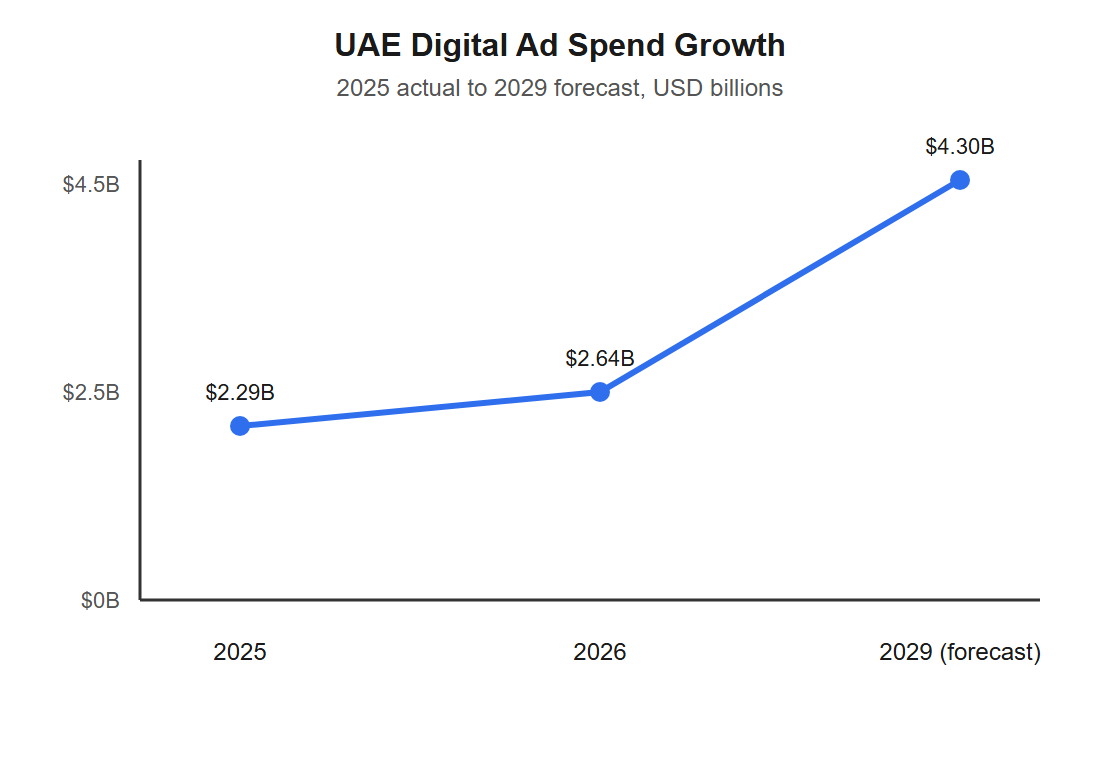
Abu Dhabi’s digital ad market is on track to grow 15.2% in 2026, reaching roughly $2.64 billion, after posting a 12.8% compound annual growth rate between 2020 and 2025 (United Arab Emirates Digital Ad Spend Report, 2026). That growth is good news for the industry, but it also means more agencies are chasing your budget than ever before — and not all of them will be a fit for your business.
Search for “digital marketing companies abu dhabi” and you’ll mostly find unranked directories: dozens of agency names with generic descriptions like “results-driven” or “innovative,” but no real way to tell which one is actually right for you. This guide skips the popularity contest. It walks through how to define what you need, what digital marketing actually costs in Abu Dhabi by company size, the questions worth asking before you sign anything, and the red flags that should make you walk away.
Key Takeaways
- Abu Dhabi’s digital ad market is growing more than 15% a year, which means more agencies competing for your attention — evaluate carefully rather than picking from the top of a list.
- Digital marketing spend should scale with your business size: startups typically invest 15–20% of revenue, established SMEs 8–12%, and large companies 6–10%.
- The strongest signal of a good agency fit is industry-specific evidence and transparent reporting, not portfolio size or vague promises.
- Guaranteed rankings, vanity metrics without conversion data, and opaque pricing are the clearest signs to walk away.
What a Digital Marketing Company Actually Does
Before you can evaluate agencies, it helps to know what you’re actually buying. Digital marketing is an umbrella term for several distinct disciplines, and agencies typically specialize in some combination of them: search engine optimization (SEO), paid media (Google Ads, Meta Ads), social media management, content creation, web development, branding, and email marketing.
Some agencies are full-service, covering most or all of these under one roof. Others specialize in one or two channels and partner with clients who need the rest handled elsewhere. Neither model is inherently better. A specialist SEO shop can outperform a generalist agency on search results. A full-service agency, meanwhile, reduces the coordination overhead of managing multiple vendors. The right choice depends on what you’re trying to achieve — exactly what the next section covers.
Step 1: Define What You Actually Need Before You Start Evaluating
The single biggest mistake businesses make when hiring a digital marketing company is comparing agencies before deciding what success looks like. For example, an agency that’s excellent at paid lead generation for a real estate developer isn’t automatically the right choice for a hospitality brand trying to build long-term social following. The skill sets, timelines, and success metrics are different.
Start by answering three questions: What’s the primary business goal — more leads, more brand awareness, more direct sales? What channels matter most for your audience — is your customer searching on Google, scrolling Instagram, or both? And has the agency worked with businesses in your industry before, with evidence you can actually check?
That last point matters more than most buyers realize. An agency’s general portfolio tells you they can produce good-looking work. Industry-specific experience tells you something more useful: they already understand your customer’s buying behavior, where you stand against competitors, and which channels actually convert in your category. That shortens the ramp-up time before you see results.
If you’d rather start from a clear answer to those three questions than piece one together yourself, that’s the first conversation we have as part of our digital marketing services
Step 2: Understand What Digital Marketing Costs in Abu Dhabi
Once you know what you need, the next filter is budget. This is where a lot of buyers get misled — either by quotes that are suspiciously cheap, or by pricing that only becomes clear after signing. Spend benchmarks vary by company stage. Knowing where you fall helps you sanity-check any quote you receive.
Startups typically invest 15–20% of annual revenue in digital marketing. That’s because they need to build visibility from a standing start. Established SMEs tend to spend less — 8–12% of revenue — once a baseline audience and reputation are already in place. Larger companies generally spend 6–10% of sales. Their marketing budgets are proportionally smaller relative to revenue, even as the absolute dollar amount is higher.
These bands aren’t UAE-specific research. They’re a widely cited industry rule of thumb. Two respected benchmark surveys echo the same pattern with some variation: Gartner’s CMO Spend Survey and the Deloitte/Duke CMO Survey. Both show smaller, younger companies spending a higher share of revenue on marketing than established enterprises.
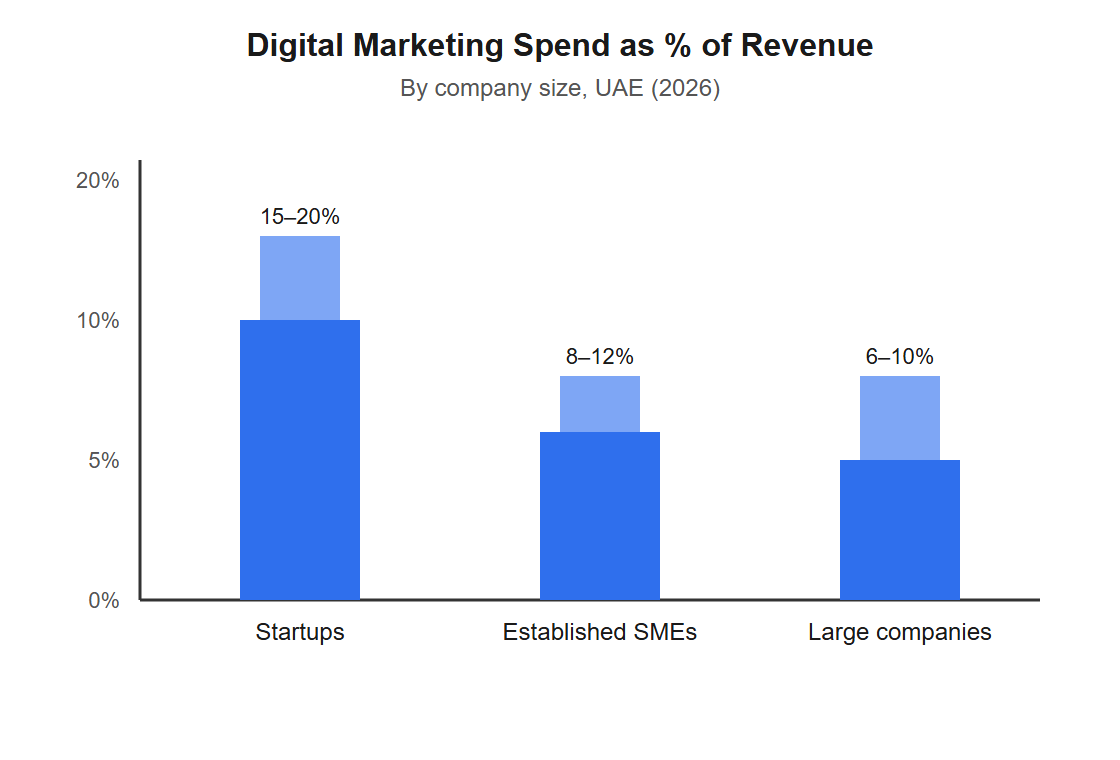
Our take: These spend bands aren’t static targets — the market underneath them is moving. Abu Dhabi’s digital ad spend is growing at double digits every year through 2029, which means the competitive bar for “enough” budget rises with it. Businesses that anchor to the low end of their bracket year after year risk quietly falling behind as competitors’ effective spend grows with the market. A more defensive approach: budget toward the upper end of your bracket for a new agency relationship’s first year, then negotiate down once results are proven.
If a quote comes in dramatically below these bands, ask what’s being cut — usually it’s strategy, reporting, or account management time, not the media spend itself. If it comes in well above, ask what’s driving the premium and whether it’s tied to measurable deliverables.
Step 3: Ask These Questions Before You Sign
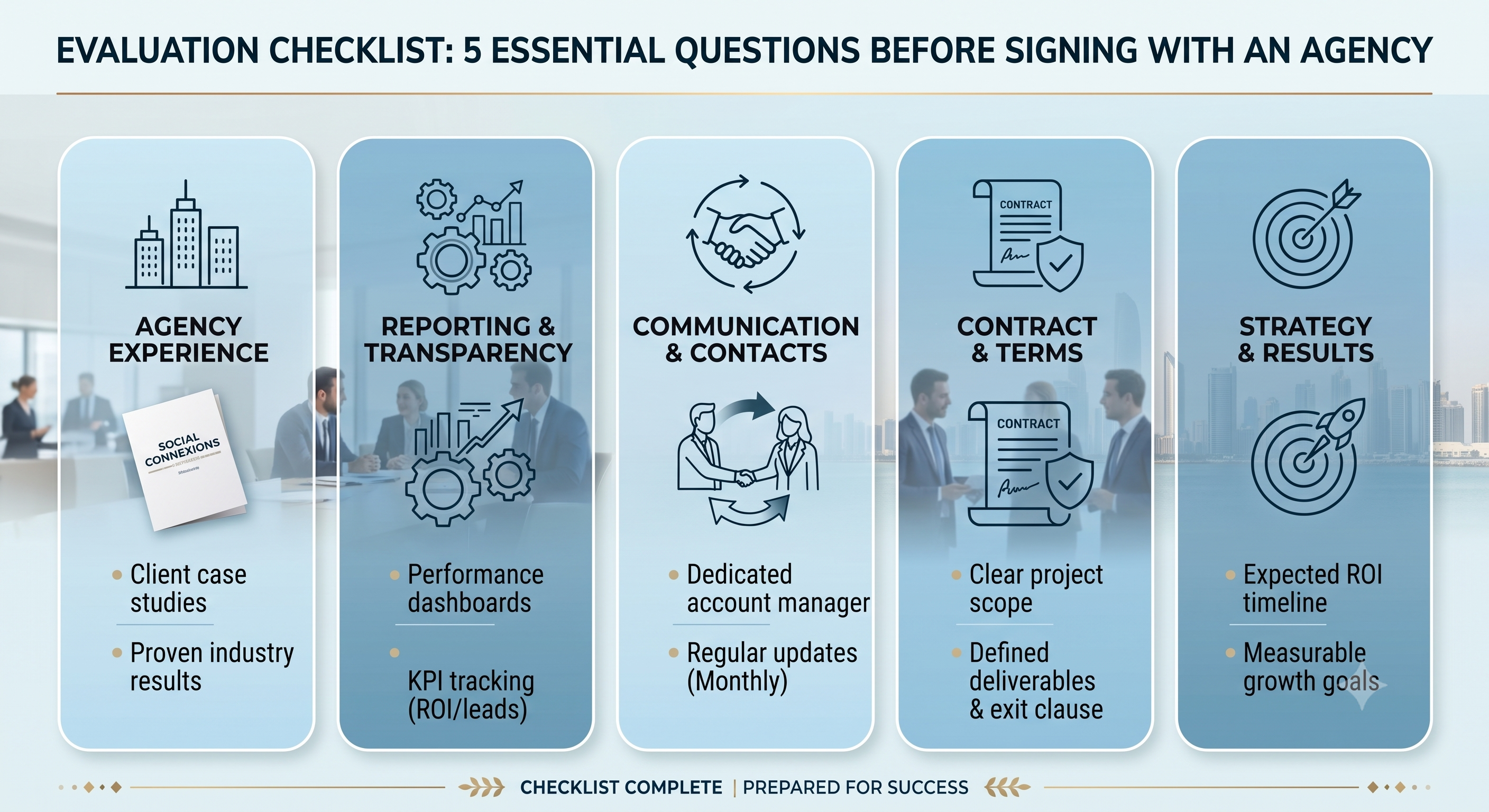
Once you’ve shortlisted a few agencies within your budget range, the evaluation gets specific. These are the questions that separate agencies that will actually move your numbers from ones that will just produce activity:
- Can you show evidence from a client in our industry? Not just a logo — ask what the engagement involved and what changed.
- How often will we see reporting, and what will it show? Look for agencies that report on outcomes (leads, conversions, revenue-attributable metrics) rather than only activity (posts published, impressions served).
- Is the work done in-house or outsourced? Outsourced production isn’t automatically bad, but you should know who’s actually executing your campaigns and how quality is controlled.
- What does the contract commit us to? Understand the minimum term, notice period, and what happens if the relationship isn’t working after three months.
- What’s a realistic timeline for results? SEO and organic growth take months; paid media can show signal within weeks. An agency that promises fast results across every channel is oversimplifying.
Red Flags That Mean You Should Walk Away
A crowded, fast-growing market like Abu Dhabi’s also attracts agencies making promises they can’t consistently deliver. A few patterns are worth treating as hard stops rather than minor concerns.
Guaranteed rankings or results. No agency controls Google’s algorithm or a platform’s ad auction closely enough to guarantee a specific ranking or return. Guarantees like this are a sales tactic, not a technical reality.
Vanity metrics without conversion data. Follower counts, impressions, and reach numbers are easy to inflate and don’t necessarily correlate with leads or sales. Ask how activity connects to your actual business outcomes.
Opaque pricing. If an agency can’t clearly explain what you’re paying for — media spend versus management fee versus production costs — that’s a preview of how transparent their reporting will be later.
No local market evidence. A portfolio built entirely outside the UAE doesn’t tell you how an agency will perform against Abu Dhabi’s specific competitive and cultural context, including bilingual Arabic/English audience needs where relevant.
Why Abu Dhabi’s Market Makes This Evaluation Especially Important Right Now
As noted above, the UAE’s digital ad spend market is forecast to grow fast — a 17.7% compound annual rate between 2026 and 2029. That means roughly $2.29 billion in 2025 growing to about $4.30 billion by 2029. A population that’s almost entirely online is driving that growth: the UAE had 11.1 million internet users at the start of 2025, at 99.0% internet penetration (DataReportal, Digital 2025: United Arab Emirates). Smartphone penetration adds to the picture, estimated at around 95% heading into 2026. That figure converges across several market-data aggregators rather than coming from one single benchmark report.
In practical terms, more businesses are competing for attention in the same digital channels. More agencies are entering the market to serve them. Neither trend makes any individual agency more or less trustworthy. But it does mean the cost of picking the wrong partner keeps rising as the market gets more crowded — wasted budget, lost time. Diligence upfront is cheaper than a mid-contract switch.
Frequently Asked Questions
How do I choose a digital marketing agency in Abu Dhabi?
Start by defining your primary goal and target channels, then shortlist agencies with verifiable experience in your industry. Compare them on reporting transparency, contract flexibility, and realistic timelines rather than portfolio size alone — the step-by-step framework above walks through each of these in detail.
What should I look for in a digital marketing company?
Look for industry-specific case evidence, clear and frequent reporting tied to business outcomes (not just activity metrics), transparent pricing, and realistic — not guaranteed — timelines for results.
How much does digital marketing cost in Abu Dhabi?
It depends on company size: startups typically spend 15–20% of revenue, established SMEs 8–12%, and larger companies 6–10% of sales — a widely cited industry benchmark range rather than a UAE-specific figure. Use these bands to sanity-check any quote you receive.
What are red flags when hiring a digital marketing agency?
Guaranteed rankings or results, vanity metrics reported without conversion data, opaque pricing structures, and an absence of local UAE market evidence are the clearest warning signs.
Conclusion
Choosing a digital marketing company in Abu Dhabi comes down to four steps. Define what success looks like before you start comparing agencies. Sanity-check pricing against real benchmarks for your company size. Ask the questions that reveal how an agency actually operates. And treat guaranteed results or opaque pricing as hard stops. In a market growing this fast, the businesses that take the time to evaluate properly are the ones that avoid wasting a budget cycle on the wrong fit.
If you’d rather talk through your specific goals than run this evaluation alone, contact Social Connexions to book a consultation and we’ll walk through what a fit would actually look like for your business.
Tagged with :