

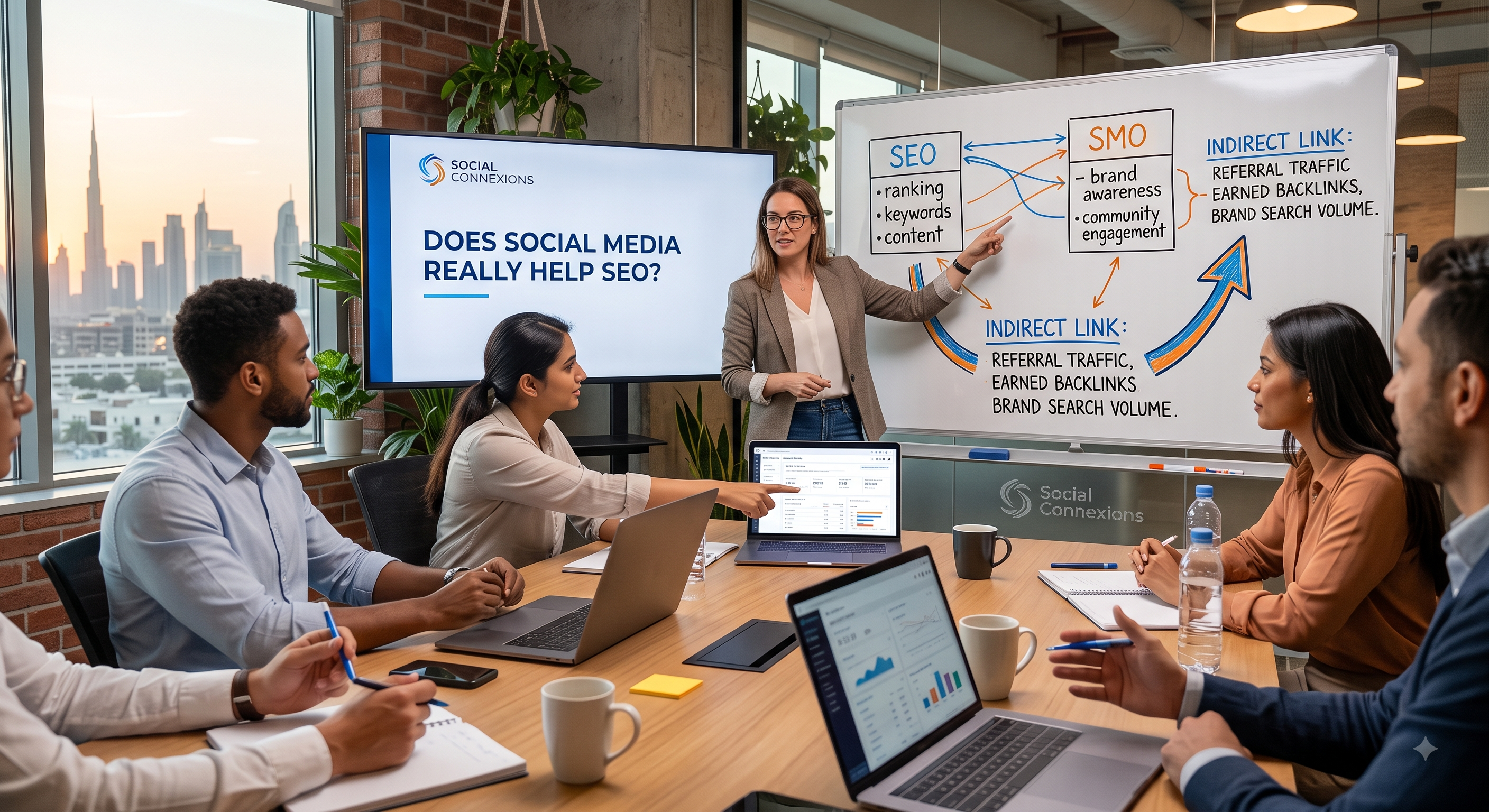
Search “does social media help SEO” and you’ll get two confident, opposite answers. One camp says social media has zero effect on rankings. The other sells “SEO through social media” as if posting more on Instagram will move you up Google’s results page. Both are wrong, in different directions.
This guide covers what’s actually true: what Google has said directly about social signals, and the real, indirect ways social media does affect search visibility. It also covers how SEO and SMO — Social Media Optimization — should work together rather than compete for the same budget line. Whether you’re comparing SEO and SMO services in Dubai as separate line items or looking for one team to handle both, the framework below should make that decision easier.
Key Takeaways
- SEO and SMO are different disciplines: SEO ranks your website on Google, SMO builds visibility and engagement on social platforms.
- Google has stated directly that social signals — likes, shares, follower counts — are not a ranking factor. John Mueller, Google’s Search Advocate, put it plainly: “Sorry, we don’t use likes as a ranking factor” (Search Engine Journal, Are Social Signals a Google Ranking Factor?, 2021).
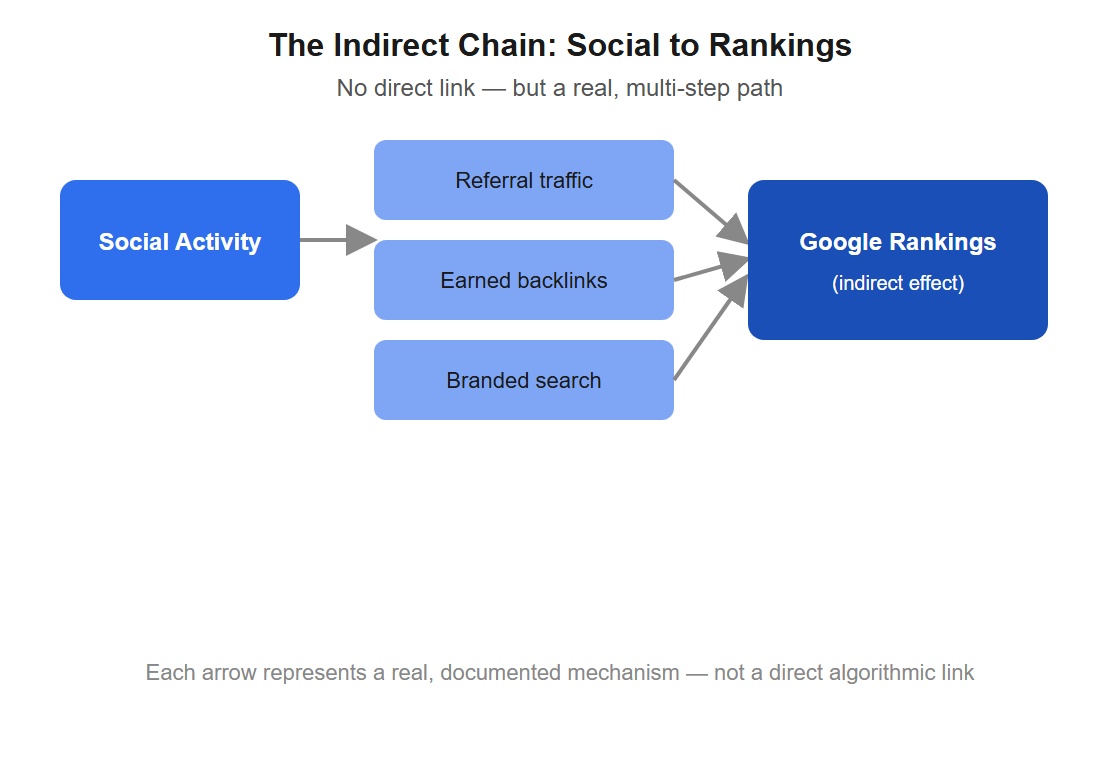
- Social media still affects SEO indirectly — through referral traffic, earned backlinks, and increased branded search volume.
- In 2026, social proof increasingly affects whether AI search tools cite your content at all, which is a newer reason the two disciplines are worth coordinating.
What SEO and SMO Actually Are (And How They’re Different)
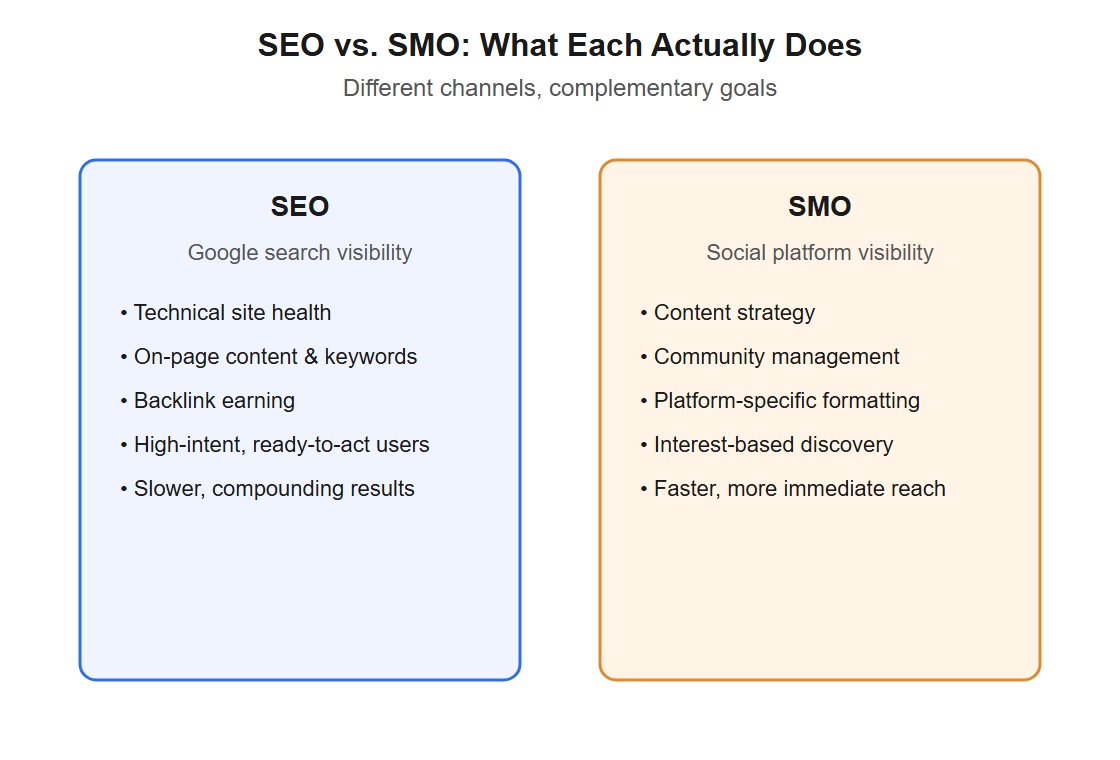
SEO (Search Engine Optimization) is the work of making a website more visible in Google’s organic search results — technical site health, on-page content and keyword targeting, and earning links from other credible sites. SMO (Social Media Optimization) is the work of building visibility and engagement on social platforms — content strategy, community management, platform-specific formatting, and often paid social alongside organic posting.
The two disciplines target different behavior. SEO captures people who are already searching for something specific — high intent, ready to act. SMO reaches people based on interest and discovery, often before they know they’re looking for a solution at all.
Does Social Media Actually Affect SEO Rankings?
No — not directly. Google has said this plainly and repeatedly. John Mueller, Google’s Search Advocate, has stated on multiple occasions that social signals like likes, shares, and follower counts are not part of Google’s ranking algorithm. Asked directly whether likes function as a ranking factor, his answer was: “Sorry, we don’t use likes as a ranking factor” (Search Engine Journal, Are Social Signals & Shares A Google Ranking Factor?, 2021).
This matters for how you budget and set expectations. If an agency is selling “SEO through social media” on the premise that posting more will directly move your Google rankings, that’s not how the algorithm works. It’s worth asking them to explain the actual mechanism rather than taking the claim at face value. For the fuller set of questions worth asking any SEO vendor, our guide to choosing an SEO company in Abu Dhabi covers that evaluation in detail.
Worth knowing: Most major social platforms — including Facebook, Twitter/X, LinkedIn, and Pinterest — require inbound links to carry a nofollow attribute by default (Ignite Visibility, What Is a Nofollow Link?, retrieved 2026). Google’s own documentation describes nofollow as the value to use “when you’d rather Google not associate your site with, or crawl the linked page from, your site” (Google Search Central, Qualify Your Outbound Links to Google, retrieved 2026). That’s a separate, verifiable reason social shares don’t function like a genuine editorial backlink — on top of Google’s own statement that likes and shares aren’t a ranking signal at all.
The Real, Indirect Ways Social Media Helps SEO
Social media not moving rankings directly doesn’t mean it’s irrelevant to SEO — it moves several things that genuinely do matter for search visibility.
Referral traffic: content shared on social platforms drives visitors to your site, and that traffic can generate the early engagement signals search engines do consider when evaluating content quality.
Earned backlinks: content that gets seen and shared widely on social media is more likely to get discovered and linked to by other sites and journalists — and those links are a genuine, direct ranking factor.
Branded search volume: consistent social presence builds brand awareness, and people who recognize your brand are more likely to search for it by name later — a signal that does correlate with authority in Google’s eyes.
Faster discovery and indexation: actively sharing new content on social platforms can help it get discovered and crawled faster than waiting for organic discovery alone.
The 2026 Wrinkle — Social Proof and AI Search Citations
There’s a newer reason SEO and SMO are worth coordinating that goes beyond classic Google rankings. As AI search tools like ChatGPT, Perplexity, and Google’s AI Overviews decide what content to cite, they increasingly favor content with visible signals of real-world relevance and trust — and social validation is one of those signals.
None of the major AI platforms fully disclose how their citation systems weigh this, so it’s worth treating this as an observed pattern rather than a confirmed algorithmic rule. The practical implication holds either way. Content that’s genuinely useful enough to get shared and discussed on social platforms is more likely to build the kind of visible authority that both classic search and AI search surfaces reward.
How to Actually Combine SEO and SMO Strategy
Coordinating the two disciplines is more practical than most businesses assume:
- Build content for both channels from the start. A blog post written with SEO structure (clear headings, answer-first sections) can be repurposed into social posts without starting from scratch.
- Cross-promote deliberately. Share blog and service-page content on social channels, and link back to relevant pages from social bios and posts where the platform allows it.
- Use social listening for content ideas. Questions and comments on social platforms often reveal exactly what your audience is searching for — direct input for keyword and topic research.
- Track both channels’ contribution to the funnel, not just their own in-channel metrics. A social post that drove a visitor who later converted from an organic search deserves credit in both directions.
Do You Need Separate Services, or One Integrated Team?
It depends on scale. Smaller businesses often benefit from one team handling both SEO and social — it keeps messaging, content calendars, and reporting consistent, and avoids the coordination overhead of two separate vendors working from different plans.
Larger businesses with more complex needs may genuinely need channel specialists. Even then, the two teams should be coordinating closely rather than working in silos. If you’re evaluating a vendor for either service, ask directly how they coordinate with (or would coordinate with) the other channel — a vague answer is worth treating as a flag. If social media is the piece you’re evaluating right now, our guide to choosing a social media company in Dubai covers the same kind of vendor-evaluation framework for that specific channel.
Frequently Asked Questions
What is the difference between SEO and SMO?
SEO (Search Engine Optimization) makes a website more visible in Google’s organic search results through technical health, content, and backlinks. SMO (Social Media Optimization) builds visibility and engagement on social platforms through content strategy, community management, and platform-specific formatting. They’re different disciplines that work toward a shared goal of overall online visibility.
Does social media help SEO rankings?
Not directly — Google has stated that social signals like likes, shares, and follower counts are not a ranking factor. But social media helps indirectly, by driving referral traffic, earning backlinks, and building the brand awareness that increases branded search volume, all of which do relate to how content performs in search.
Do I need both SEO and social media marketing?
Most businesses benefit from both, ideally coordinated rather than run as separate, disconnected efforts. The right balance depends on where your audience actually spends time and how they typically discover businesses like yours.
How does social media affect AI search visibility?
AI search tools appear to favor content with visible signals of real-world relevance and trust when deciding what to cite, and social validation is one such signal. This isn’t a fully disclosed or confirmed mechanism on any platform, so treat it as an observed pattern worth factoring into strategy rather than a guaranteed rule.
Conclusion
SEO and SMO are different disciplines that answer different questions — one gets you found on Google, the other builds visibility and engagement on social platforms. Social media doesn’t move Google rankings directly, whatever an oversimplified pitch might claim. But it genuinely does help indirectly through traffic, backlinks, and brand search, and it increasingly matters for AI search citation too. The businesses that benefit most treat the two as coordinated parts of one strategy, not competing budget lines.
If you’d rather have a team handle both in a coordinated way, our SEO services and our social media marketing services work together at Social Connexions rather than in separate silos — contact us to book a consultation and we’ll walk through what that would look like for your business.
Tagged with :