
Digital Marketing
42 Minute
Top 10 Questions to Ask Before Hiring a Performance Marketing Agency in Dubai


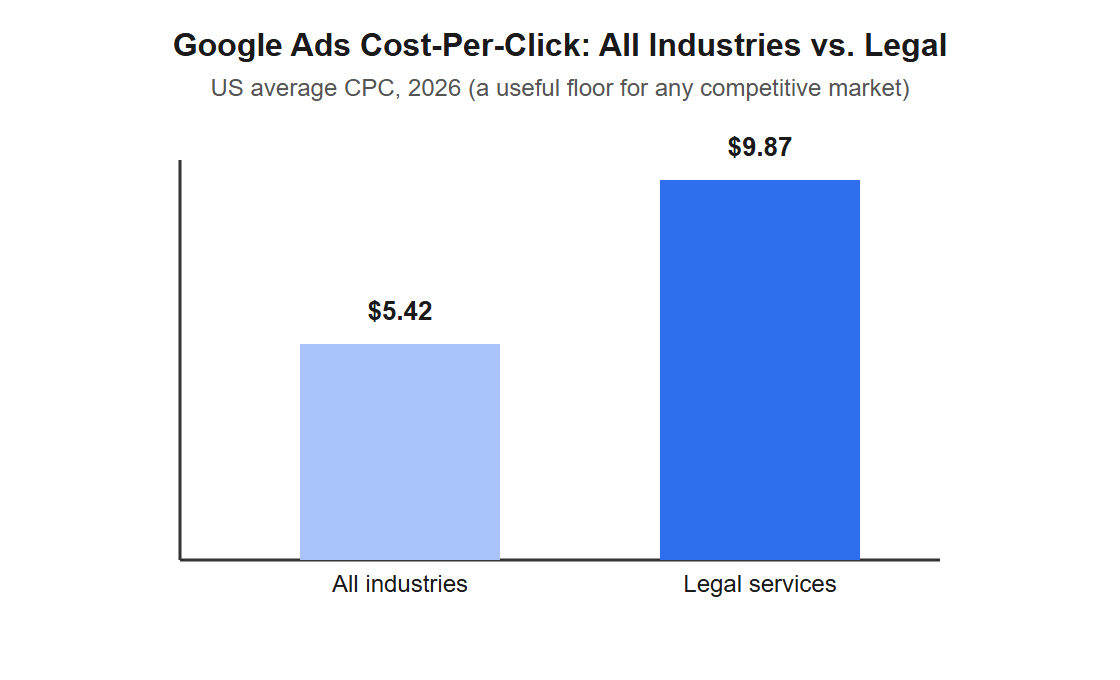
Paid clicks are not cheap anywhere, and the numbers back that up: across the US, the average Google Ads cost-per-click in 2026 is $5.42, and in the most competitive verticals like legal services it runs as high as $9.87 per click, with a cost-per-lead of $131.63 (WordStream, Google Ads Benchmarks 2026). Dubai advertisers face the same dynamic in a small, competitive market — every click a business buys is a real cost, and whoever spends that budget on your behalf is one of the highest-leverage vendor decisions you’ll make this year.
The problem: search “performance marketing agency Dubai” and almost every result describes itself the same way — full-funnel, data-driven, ROI-focused. That language tells you nothing about whether the agency behind it can actually prove your ad spend turned into revenue. This isn’t a broad “how do I pick a marketing partner” guide — for that, see our full evaluation framework for choosing a digital marketing company. This one starts with what performance marketing actually means, covers the agency-vs-consultant choice, then walks through the 10 questions that separate a partner who can prove performance from one who’s just spending your money and hoping.
Key Takeaways
- Performance marketing means paying for a measurable outcome — a lead, a sale, a signup — not for impressions or reach.
- A performance marketing agency and a performance marketing consultant solve different problems: scope and channel count should drive that choice, not budget alone.
- You should own your ad accounts and data outright; agency-owned accounts create switching costs and data-loss risk if the relationship ends.
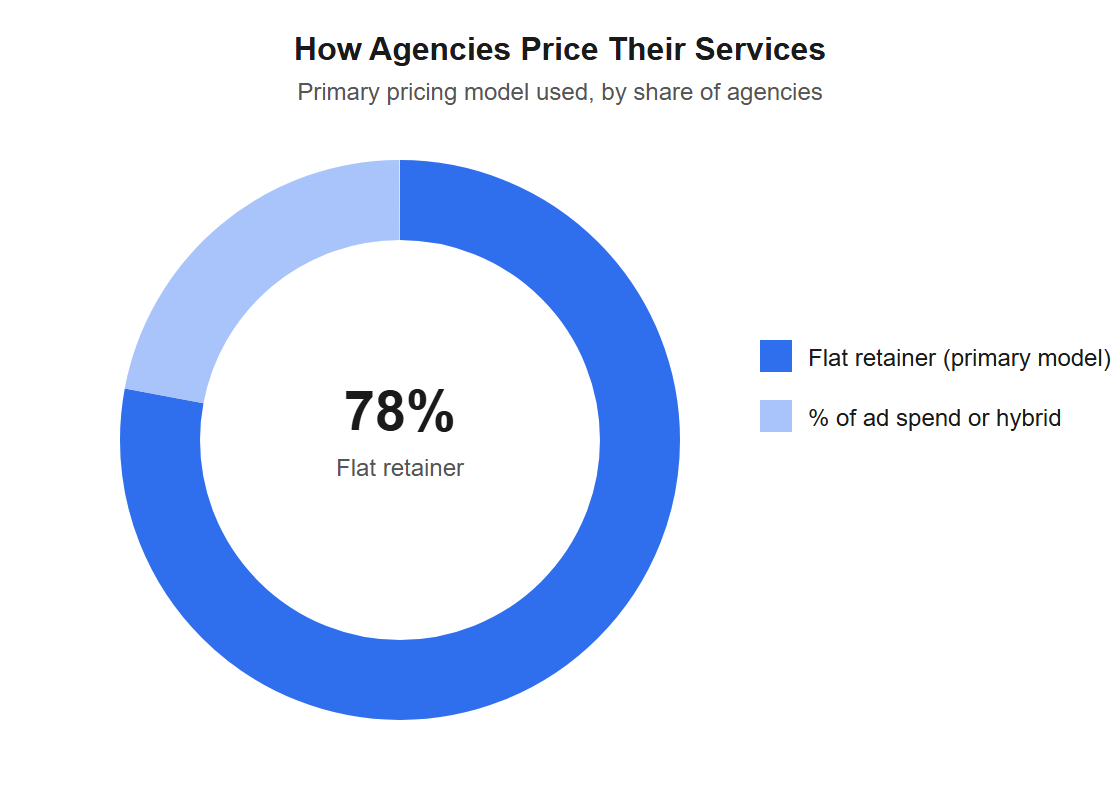
- Agencies price in one of three ways: a flat retainer (the dominant model, roughly 78% of agencies use it as their primary structure, typically $1,500–$10,000+/month), a percentage of ad spend (commonly 10–20% of media budget), or a hybrid of the two (sources cited below).
What Is Performance Marketing, Exactly?
Performance marketing is digital advertising where you pay for a measurable result — a click, a lead, a sale — rather than for exposure, the way a print ad or a billboard is priced. A performance marketing agency runs and optimizes paid campaigns (Google Ads, Meta Ads, TikTok, programmatic) against a defined outcome, and its fee is tied, directly or indirectly, to that outcome improving.
This is narrower than “digital marketing” as a whole. A digital performance marketing agency typically focuses on paid acquisition channels specifically, whereas a general digital marketing agency might also cover organic SEO, content, branding, and social community management — work that isn’t measured the same way and doesn’t scale the same way with budget.
It’s also worth knowing the alternative to an agency: a performance marketing consultant — typically an independent specialist who manages strategy and campaign setup directly, often for a flat fee rather than a percentage of spend. A consultant can be a good fit for a single-channel, well-defined campaign where you don’t need a full production team. An agency makes more sense once you’re running multiple platforms at once, need creative production alongside media buying, or want redundancy if one person is unavailable. Neither option is universally better — it depends on how many channels you’re running and how much hands-on production support you actually need.
1. How Exactly Do You Measure Success?
A real performance marketing agency ties ad spend to a business outcome — a lead, a sale, a signup, a piece of qualified pipeline — not to impressions, reach, or click volume.
Red flag: reporting stops at cost-per-click, click-through rate, or impressions, with no connection back to what those clicks actually did for your business.
Good sign: before the campaign starts, the agency defines the metric that matters — cost per lead, return on ad spend, or customer acquisition cost — and agrees on it with you in writing. If they can’t name the metric before they’ve spent your budget, they won’t be able to report against it after.
2. Who Owns the Ad Accounts and Data?
You should own your Google Ads, Meta Ads Manager, and analytics accounts outright, under your own business — not under the agency’s.
Red flag: the agency creates and holds all ad accounts under their own manager account (MCC or Business Manager), with no transfer clause in the contract.
Good sign: accounts are created under your business from day one, or the contract explicitly guarantees a full handover of accounts, historical data, and audience lists if the relationship ends. This single question protects you from the most common way a business loses leverage with an underperforming agency — you can’t walk away without losing years of campaign history and retargeting audiences.
3. What’s the Fee Structure — and Does It Scale With Spend?
Ask this before you compare any two quotes, because “performance marketing agency” pricing hides behind three common models.
The dominant model is a flat monthly retainer — around 78% of agencies use it as their primary pricing structure (Admiral Media, Performance Marketing Agency Pricing, 2025), typically running $1,500–$10,000/month for small-to-mid-market engagements, and $5,000–$25,000+/month for full-service, multi-channel programs (Scopic Studios, Digital Marketing Agency Pricing, 2026). The second is a percentage of ad spend, commonly 10–20% of the media budget — a model that scales with your investment, for better or worse: at a $200,000/month spend, a 15% fee alone is $30,000/month (Darkroom, Marketing Agency Cost 2026, 2026). A growing number of agencies now use a hybrid: a lower base retainer paired with a variable fee tied to results — leads, attributed revenue, or ROAS — or a flat base plus a lower percentage above a spend threshold, for example an $8,000/month base plus 8% of spend above $50,000 (Darkroom and Scopic Studios, both cited above).
None of these models is inherently better. What matters is that you know which one you’re being quoted, and that the percentage-of-spend model doesn’t create a perverse incentive to inflate your budget rather than improve your results.
| Pricing Model | Typical Range | How It Scales |
|---|---|---|
| Flat retainer | $1,500–$10,000+/mo (small-to-mid); $5,000–$25,000+/mo (full-service) | Fixed — doesn’t change with ad spend |
| % of ad spend | 10–20% of monthly media budget | Scales directly with spend — e.g., $30,000/mo in fees at $200,000/mo spend, 15% |
| Hybrid | Base retainer + lower % above a threshold, e.g., $8,000/mo + 8% above $50,000 | Partly fixed, partly variable — often tied to results (leads, revenue, ROAS) |
4. What Platforms Do You Actually Specialize In?
“We do everything” is a weaker signal than deep expertise in the one or two channels that actually reach your audience. Google Ads/Search, Meta and social, and programmatic/CTV each require different skill sets, creative approaches, and optimization habits.
Ask for platform-specific case evidence — not a generic portfolio — for the channel your customers actually use. An agency that’s excellent at Meta lead-gen campaigns for a real estate developer isn’t automatically the right fit for a B2B business whose buyers are searching Google.
Two follow-up questions are worth asking directly. First, who runs the day-to-day work on your priority platform — a dedicated specialist, or a generalist account manager spreading attention across Google, Meta, TikTok, and programmatic all at once? Second, what tools and reporting stack do they actually use — a real ad-tech stack (bid management, conversion tracking, attribution) signals a team built for scale, while manual spreadsheet reporting signals a smaller, less mature operation regardless of what the pitch deck claims.
5. How Much Should I Expect to Spend on Media (Separate From Fees)?
Media budget and agency fee are two different line items, and conflating them is one of the most common ways buyers get an unpleasant surprise mid-contract. Whatever fee model you agree on, expect a meaningful, separate slice of your budget to go directly to the ad platforms themselves.
That media line item is not trivial. Even in a large, mature market like the US, the average Google Ads CPC across all industries sits at $5.42, and the most competitive verticals — legal services, for example — run closer to $9.87 per click with a cost-per-lead north of $130 (WordStream, Google Ads Benchmarks 2026, cited above). Dubai’s ad market is small and dense with well-funded competitors bidding on the same keywords, so treat US benchmarks as a floor, not a ceiling, when sizing a realistic test budget — and ask any agency you’re evaluating to show you the actual CPC and CPL ranges they’ve seen in your specific industry, rather than relying on generic averages from either side of the world.
If you’d rather have someone else size the test budget and run the numbers, that’s exactly what our performance marketing services are built to do.
6. How Often Will I See Reports, and What Do They Actually Show?
Reporting cadence and depth reveal whether an agency is managing toward outcomes or just producing an activity log. Ask whether you’ll get live dashboard access — through a tool like Looker Studio — or only a static PDF export on a fixed schedule.
Red flag: reports are a wall of numbers — spend, clicks, impressions — with no interpretation.
Good sign: reports pair the numbers with what the agency concluded from them and what they’re changing next. A report that doesn’t lead to a decision isn’t doing its job.
7. Can You Show Evidence From My Industry, Not Just Your Portfolio?
A polished portfolio proves an agency can produce good-looking creative. Industry-specific evidence proves something more useful: they already understand your customer’s buying behavior, your competitive set, and which channels actually convert in your category — which shortens the ramp-up time before you see real results.
Ask for the metric, the timeframe, and a business of comparable size — not just a logo, and not a generic pitch-deck slide. If the agency has written case studies with real results, that’s a stronger signal than a portfolio grid — treat vague “we’ve worked with businesses like yours” language as marketing copy, not evidence.
There’s a practical reason this matters in a market like Dubai’s: with well-funded competitors bidding aggressively across the same categories, an agency that already knows which keywords, audiences, and ad formats convert in your industry gets you to profitable results faster than one that’s learning your business on your budget. Ask how long their typical ramp-up period is before a new campaign hits its target cost-per-lead or ROAS, and what data they use to shorten it.
8. What Happens If a Campaign Underperforms?
This question reveals whether an agency treats underperformance as a signal to diagnose or a reason to keep spending and hope it improves. Ask what their kill criteria are — the point at which they’ll pause or restructure a campaign rather than let it keep burning budget — and how often they review and adjust targeting, bidding, and creative.
Also confirm whether that optimization work is included in the fee you’re already paying, or billed as a separate project. Some agencies quote a low retainer and then bill hourly for every adjustment.
Push for a concrete example rather than a philosophy. A strong answer sounds like: “we review performance weekly, pause any ad set that misses target CPA by more than 20% after a defined learning period, and test one new creative or audience variant per cycle.” A weak answer stays abstract — “we’re always optimizing” — without naming a threshold, a cadence, or a specific past example of a campaign they changed course on.
9. Who Is My Point of Contact, and What’s Their Actual Availability?
A named, senior point of contact with clearly defined response times matters more than a large account team on a pitch deck. Ask specifically who manages your account day-to-day, how quickly they respond to questions, and what happens if that person leaves the agency — is there documented continuity, or does your campaign knowledge walk out the door with them?
10. What Does the Exit Look Like If This Doesn’t Work Out?
Contract length, notice period, and data handover terms should be clear before you sign — not negotiated after a bad quarter. Ask directly: is this month-to-month or locked in for a fixed term? What’s the notice period to end the relationship? And critically, tying back to Question 2 — what happens to your historical campaign data, audience lists, and account access at termination?
An agency confident in its own performance will have straightforward answers to all three. Vague or evasive answers here are often the clearest red flag in the whole conversation.
Conclusion
Ten questions, but a few ideas underneath them matter most: measurement clarity, account ownership, fee transparency, and a clean exit. Whether you land on a full agency or a performance marketing consultant, a partner that can answer all of these directly — with specifics, not marketing language — is one that’s built to prove performance, not just claim it. Given how expensive competitive ad clicks already are, that clarity is worth insisting on before a single dirham of your budget is spent.
If you’d rather walk through these questions with an agency directly than run this checklist cold, book a consultation with Social Connexions and we’ll show you exactly how we’d answer each one.
Tagged with :